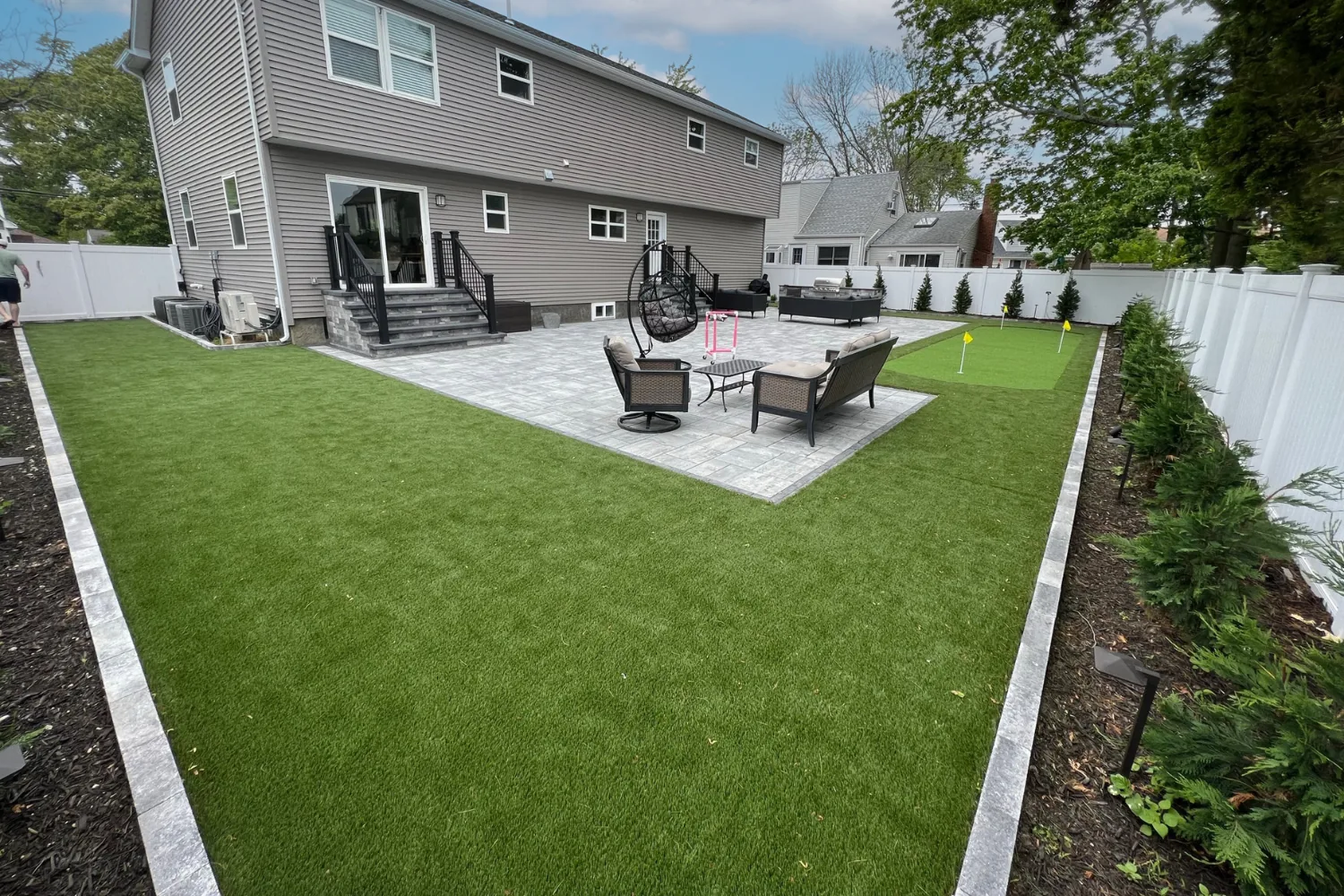
In San Angelo, the green blades you actually see are the smallest part of an artificial turf project. What decides whether a lawn stays flat, drains after a Concho Valley cloudburst, and survives fifteen West Texas summers is everything hidden below the surface: the excavation, the base rock, and the compaction. A turf lawn is really a small piece of civil engineering wearing grass. Here is how a professional install comes together on a typical Tom Green County lot, stage by stage, and why each step earns its place in our caliche soil and punishing UV.
Homeowners in Grape Creek and Wall often ask why two installs at the same price can look so different after a couple of years. The answer is almost always the base. San Angelo sits on caliche, a hardpan that turns to rock when it is dry and swells when it finally gets rain. A turf lawn built straight on native soil will heave, dip, and hold water. Everything below the turf exists to give the blades a stable, free-draining platform that ignores our wet-dry swings.
Get this stage right and the rest of the install is almost cosmetic. Get it wrong and no amount of premium grass will save the lawn.
The crew starts by killing and stripping the existing Bermuda or St. Augustine, then cutting down three to four inches of soil with a sod cutter or mini-skid. In much of San Angelo this means fighting caliche that is nearly as hard as concrete when the ground is dry, so we often water the area a day ahead to make digging cleaner. Spoils are hauled off rather than spread, because leaving organic soil under turf invites settling and weeds. On homes near the river or on older Lake View lots, we also check for irrigation lines and cap or reroute heads.
Next comes the layer that does the real work: three to four inches of crushed rock, typically a decomposed-granite or road-base blend that packs tight yet still drains. The crew grades it to a gentle slope, usually a quarter-inch of fall per foot, always pushing water away from the foundation. This matters more than people expect in the Concho Valley, because our rain arrives in short, intense bursts rather than steady drizzle. A base that sheds a two-inch downpour keeps the turf firm and the yard usable an hour later.
The base is wetted lightly and run over with a plate compactor until it hits roughly ninety percent density, the point where a footprint no longer leaves a dent. A weed membrane goes down to block the stubborn West Texas invaders, and rigid bender board or steel edging locks the perimeter so borders stay crisp against flower beds, decomposed-granite paths, and the driveway. Skipping compaction is the single most common shortcut we are called out to fix.
The turf itself is unrolled and left to relax in the San Angelo sun for an hour or two first. This step is non-negotiable in our heat: synthetic grass expands as it warms, and installing it cold leads to wrinkles once summer hits. Every panel is laid with the blade grain running the same direction so the lawn reads as one uniform color. Seams are joined with outdoor seam tape and adhesive, hidden by hand-tucking blades over the joint, then the perimeter is nailed with galvanized spikes every few inches. Good seaming is invisible; bad seaming shows a line for the life of the lawn.
With the turf anchored, the crew brushes in infill, usually rounded silica sand, or an antimicrobial coated infill for dog owners in pet-heavy neighborhoods. Infill weighs the turf down, keeps blades standing upright, and actually helps the surface stay cooler underfoot. A power broom lifts the fibers so the lawn looks full and natural, and a final rinse settles everything. The Synthetic Turf Council publishes base and infill guidelines that a reputable installer will follow; you can review them at syntheticturfcouncil.org.
A correctly built lawn in San Angelo shows no seams, sheds a hard rain in minutes, and still sits flat after a full cycle of hundred-degree afternoons and cold snaps. The blades stand up because the infill is right, and the edges stay tight because the base never moved. Every one of those results traces back to the hours the crew spent below the grass, not on it. When you compare quotes in the Concho Valley, ask less about the turf color and more about the base depth, compaction, and drainage plan, because that is what you are really buying.
Most residential yards in San Angelo and nearby Wall or Grape Creek are finished in one to three days. A small courtyard can go down in a single day, while a large backyard with tree wells, curves, and a putting green may run three. Weather rarely stops us here, but heavy caliche excavation and long haul-off can add time.
Yes to both, and each is common in Tom Green County. Over concrete we add a foam pad and drainage core so water still sheets off. Over caliche we excavate a few inches, then build a fresh crushed-rock base, because compacted caliche alone swells and shrinks with our wet-dry cycles and will telegraph bumps through the turf.
Serving San Angelo and the greater Concho Valley with water-free, drought-proof lawns.