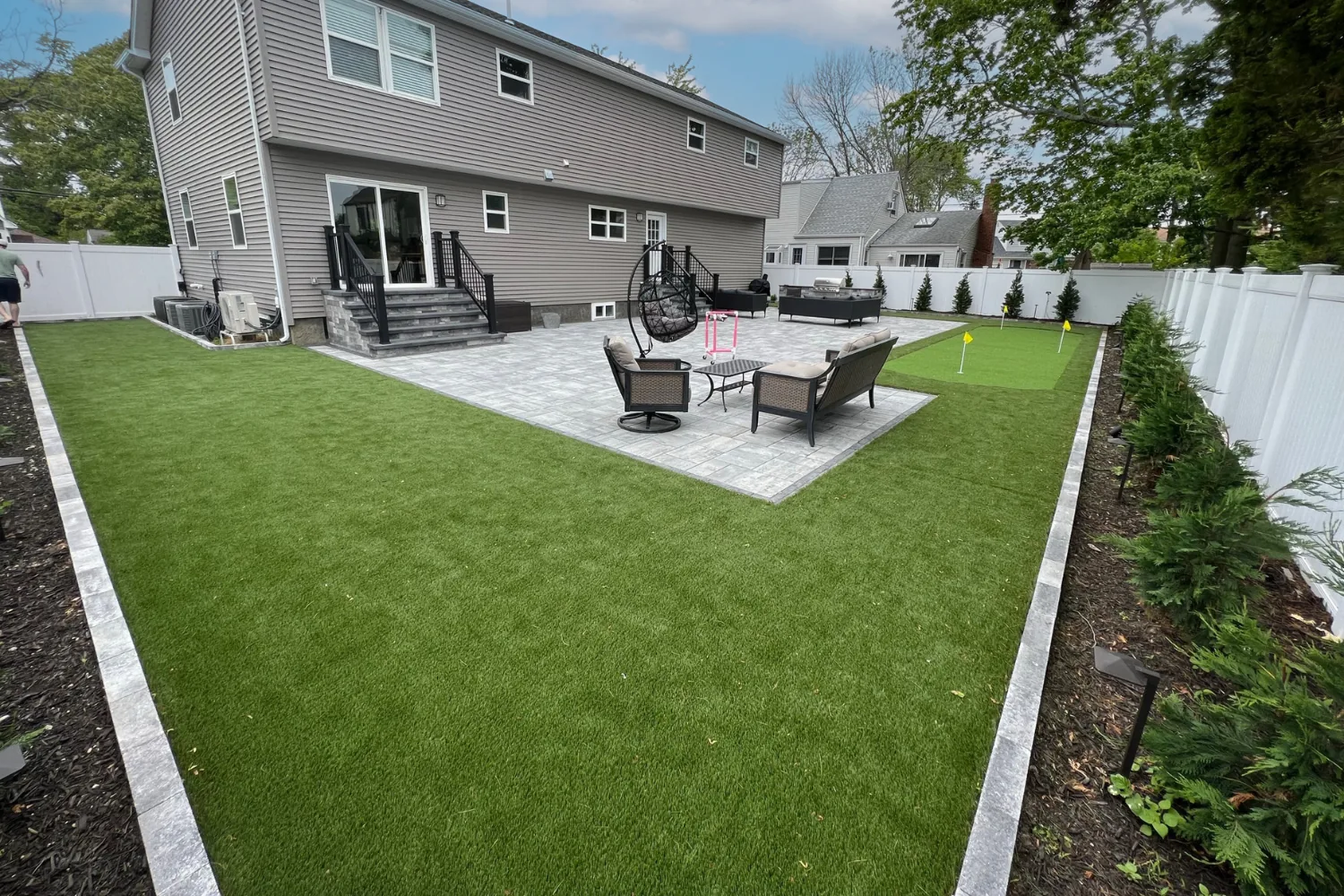
Every San Angelo homeowner who is weighing artificial turf eventually asks the same question: after a few brutal Concho Valley summers, is my lawn going to look sun-bleached and tired? It is a fair worry. West Texas hands out some of the harshest ultraviolet exposure in the country, and we see triple-digit afternoons stack up from June deep into September. Cheap outdoor materials fade here fast. The honest answer is that quality synthetic turf is engineered specifically to resist that fading, but the product you choose and the way it is installed make an enormous difference in how it holds its color a decade from now.
This guide walks through why fading happens, how far you can trust a UV-stability rating in a place like Tom Green County, and what a homeowner in Bonham Park, College Hills, or out toward Grape Creek should actually look for on a spec sheet before signing anything.
Fading is a chemistry problem. The green you see is pigment locked inside polyethylene or polypropylene blades. Ultraviolet radiation breaks the polymer chains and degrades those pigments over time, which is the same process that chalks a car hood or turns a patio umbrella pale. In the Concho Valley we get roughly 240 sunny days a year and UV index readings that regularly hit 10 or 11 in midsummer, so our turf takes more punishment in five years than an identical lawn would take in a decade near the coast.
The good news is that reputable manufacturers add UV inhibitors directly into the resin before the blades are extruded, not as a spray coating that wears off. When those stabilizers are built into the fiber, the pigment is protected from the inside out. That is the single biggest reason a bargain roll at two dollars a square foot off a marketplace listing looks gray in three summers while a properly stabilized product still reads deep green after ten. It is also why the label word you want to see is a resin-level UV package, not a topical treatment.
You will see turf marketed with UV warranties of eight, ten, even fifteen years. Read the fine print, because most of those numbers come from accelerated lab testing that assumes an average national climate. San Angelo is not average. A blade rated for a "15-year" fade resistance in a mild market may show noticeable color shift sooner here simply because our annual UV dose is higher. When we quote a lawn in the 76903 and 76904 ZIP codes, we lean toward products with heavily loaded UV packages and a manufacturer track record specifically in the desert Southwest, where the sun load is comparable to ours.
The EPA UV Index scale is a useful reference point: any reading of 8 or above is considered very high, and San Angelo sits there for months. That is the environment your turf has to survive, so the spec that matters is real-world colorfastness in high-UV zones, not a generic headline warranty.
Not sure what is on your current turf spec sheet? Send us a photo of the roll label or the product name and we will tell you honestly how it will age in San Angelo sun. Call (615) 241-0232 for a straight answer, no pressure.
Color loss is not only about the fiber. Two installation choices quietly determine how a lawn ages. First is infill. A properly infilled lawn holds the blades upright so sunlight glances off the sides rather than baking the exposed tips; a thin or settled infill layer leaves more surface directly under the sun. Second is drainage and base prep. Our caliche soil sheds water strangely, and a base that traps heat and moisture accelerates blade breakdown at the seams. A crushed-aggregate base compacted correctly keeps the whole system cooler and more stable through the freeze-thaw swings we get in January.
We also steer San Angelo clients toward lighter-toned, multi-tonal turf rather than a single saturated green. Blended olive, lime, and tan thatch fibers not only look more like a real Bermuda lawn, they disguise the very slight, even fading that any material experiences, so the yard reads natural for far longer. On a west- or south-facing front yard with no tree cover, that blended tone is the difference between a lawn that looks intentional at year eight and one that looks like a faded rug.
With a UV-stabilized product installed correctly, most San Angelo homeowners will not see meaningful fading for eight to twelve years, and even then it tends to be a uniform softening rather than blotchy discoloration. Compare that to a poorly chosen product, which can look visibly washed out in three to four summers. The gap between those two outcomes is almost entirely the fiber chemistry and the installer, which is why the cheapest bid is rarely the cheapest lawn over its life. Reflected heat is a separate hazard worth naming: low-E window glass on a nearby wall can concentrate sunlight onto a small patch and melt or discolor blades in an afternoon, so we sometimes recommend a screen or an awning for that one hot reflection.
Three questions cut through most sales talk. Ask for the exact product name and manufacturer so you can look up its UV data yourself. Ask whether the fade warranty is prorated and what a claim actually requires, because a fifteen-year number that pays pennies at year seven is not real protection. And ask how many local lawns the installer has running past the five-year mark, then ask to drive by one. A turf company that has been installing across Tom Green County for years can show you how their product looks after real West Texas summers, which is worth more than any brochure.
A few simple habits stretch the color even further. Rinse the lawn occasionally to clear dust that dulls the surface, keep magnifying objects like glass tabletops and stainless patio bowls off the turf on peak-sun days since reflected heat can singe blades, and rake high-traffic paths a couple times a year to keep infill even. None of it is demanding, and all of it is far less work than reseeding a real lawn every fall.
Artificial turf in San Angelo will not stay factory-new forever, nothing outdoors does. But choose a genuinely UV-stabilized product, insist on correct base and infill, and your lawn will still be handsomely green long after your neighbors have re-sodded twice.
San Angelo Elite Turf installs UV-stabilized synthetic lawns built for Concho Valley heat, with a free on-site estimate.
It can, because the Concho Valley gets very high UV exposure for months at a time. That is exactly why choosing turf with UV inhibitors built into the fiber, rather than a bargain product, matters so much here.
A quality UV-stabilized lawn installed correctly typically shows no meaningful color change for eight to twelve years, and the fading that does occur is gradual and even rather than blotchy.
Serving San Angelo and the greater Concho Valley with water-free, drought-proof lawns.