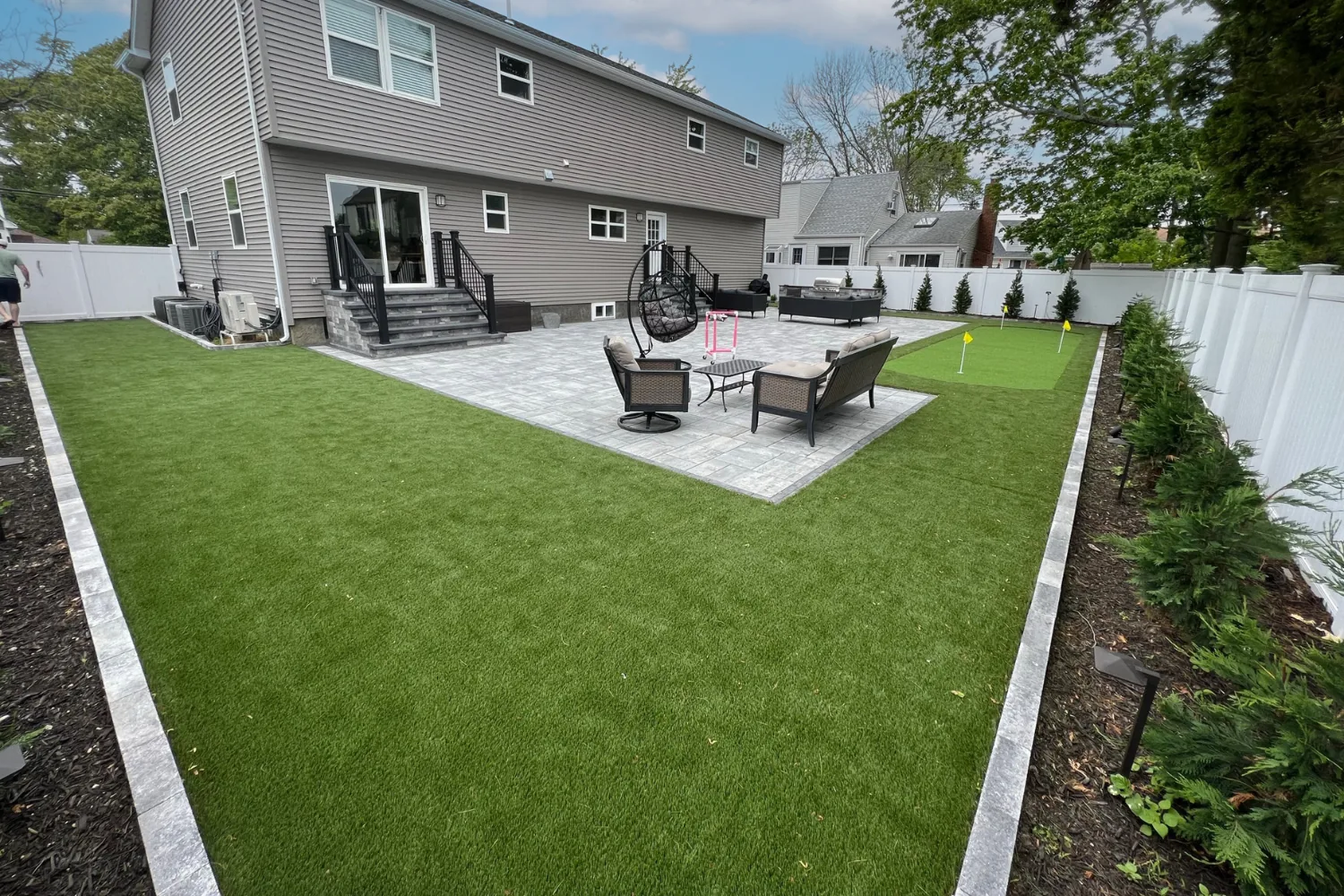
Drive through Bonham, College Hills, or any newer subdivision out toward Wall and you will see the two landscaping answers West Texas has settled on: a bed of decomposed granite and river rock, or a stretch of artificial turf. Both skip the irrigation bill, both survive a Concho Valley summer, and both show up on the same cul-de-sac. The question most San Angelo homeowners actually ask us is not which one is prettier — it is which one they will still be happy with after five Augusts of 100-degree afternoons.
This guide puts the two side by side on the things that matter here: heat, water rules, cost over time, pets and kids, and what a buyer thinks when the yard shows up in a listing photo. We install turf for a living, so take the verdict with that in mind — but the trade-offs below are honest, because rock genuinely wins in a few situations and we would rather you spend your money on the right thing.
Rock is a thermal battery. A gravel and granite bed in direct Tom Green County sun will read far hotter at the surface than the air temperature, and it holds that heat into the evening, radiating it back at your patio and through your windows. If your rock yard wraps a west-facing living room, you are effectively paying to heat the house you are trying to cool. Turf gets warm too — any surface does under our UV — but it does not store and re-radiate heat the way a mass of stone does, and a quick hose-down drops the blade temperature in minutes. For a yard people actually use in summer, that difference is the whole ballgame.
San Angelo pulls from a limited surface-water supply and moves through watering stages most years, so anything that needs irrigation is a liability. Rock and turf both clear that bar cleanly. Where they split is livability under the rules: a rock yard satisfies the ordinance but leaves you with a hardscape you cannot sit a kid or a dog on, while turf stays green, soft, and usable no matter what stage the city is in. The Texas Water Development Board pushes low-water landscaping statewide, and turf lets you comply without surrendering the backyard.
On install day rock wins, and it is not close — spreading granite and rock over fabric is one of the cheapest ways to cover dirt. The picture changes over the years. Gravel migrates: it kicks into flower beds, washes toward the curb in a Concho Valley downpour, and thins out in traffic paths, so you are buying and spreading more every couple of seasons. Weeds find the seams in the fabric and have to be pulled or sprayed. Turf is the opposite shape of spend — a bigger number once, then very little. Over a typical eight-to-ten-year window the two often land in the same neighborhood, and turf gives you a surface you enjoy the entire time.
This is where rock loses most households. Dogs will not do their business happily on hot gravel, kids will not play on it, and nobody walks it barefoot in July. Pet-rated turf drains urine straight through, rinses clean, and stays cool enough to use. If the reason you are redoing the yard is a dog or grandkids, the comparison is basically over before it starts — and if you are weighing a dog yard specifically, our guide on keeping pet turf odor-free covers the drainage and infill choices that matter in our heat.
Our caliche and clay do not drain fast, and that shapes both options. With rock, poor drainage means standing water and silt that clogs the fabric, so the bed muddies and weeds creep in. With turf, a proper crushed-base installation builds the drainage in — the base is graded and compacted so a monsoon-style downpour runs through and off instead of pooling. Either way, the dirt work is where a yard succeeds or fails here, which is also why a cheap turf job over un-prepped caliche can disappoint. Prep is everything in this soil.
A tidy rock yard reads as low-maintenance to some buyers and as bleak-and-glare to others; it is a divisive look. A clean turf lawn photographs green year-round, which is what most San Angelo buyers picture when they imagine a backyard. Neither is a guaranteed return, but turf tends to broaden your buyer pool while a full rock-scape narrows it. If resale is on your mind, our piece on whether turf adds home value in San Angelo breaks down what appraisers and agents actually say.
We will say it plainly: choose rock for pure decorative beds, tight side yards nobody walks, drainage swales, and xeriscape zones built around native plants like sage, yucca, and agave. Rock and turf are not enemies — the best Concho Valley yards often use rock borders and planting beds around a turf center that people actually live on. If you want the native-plant, low-water look without a sea of gravel, our xeriscaping-with-turf guide shows how to blend the two.
If your yard is decorative and no one needs to stand on it, rock is cheaper and fine. If you want a cool, usable, pet-and-kid-friendly space that stays green through every watering stage and still looks good in a listing photo, turf earns its higher price here — especially given what our sun does to a heat-holding rock bed. Most homeowners we work with in San Angelo, Wall, and Grape Creek end up doing both: turf where life happens, rock where it does not.
Want a straight answer for your specific yard, soil, and budget? We will walk the property, read the drainage and sun, and give you an honest turf-versus-rock recommendation — even when rock is the smarter spend. Call (615) 241-0232 for a free on-site look across the Concho Valley.
People pick rock because they picture zero upkeep, but a Concho Valley rock yard is quietly demanding. Mesquite and grass burr seeds blow in and sprout in the fines; spring brings a weed-pull or a spray pass; and after a hard West Texas rain you are re-raking gravel back out of the beds and off the sidewalk. Add a leaf blower session every few weeks to clear the dust and organic grit that settles between the stones, or the bed starts growing its own thin layer of soil. None of it is hard, but it is recurring, and it never really stops.
Turf asks less, and the chores are gentler: a cross-brush of the high-traffic lanes a few times a year to stand the blades back up, a rinse to knock down pollen and dust, and a quick pick-up after the dog. There is no mowing, no edging, no fertilizer, and no seasonal weed war along the fabric seams. For a lot of our San Angelo customers that predictability — knowing the yard will look the same in July as it did in March without a standing to-do list — is worth as much as the water savings.
One thing homeowners rarely weigh until they live with it: a big light-colored rock expanse throws glare and kicks up fine dust in our wind, which drifts onto patios, cars, and pool water. Turf does neither — it reads as a soft green field, not a reflective pan, and it holds the ground so our regular West Texas gusts are not sandblasting the back porch. If your outdoor living space sits right off the yard, that comfort difference is easy to underrate on paper and obvious the first windy evening you try to use it.
How synthetic grass fits a low-water West Texas landscape without the gravel glare.
Read article →Per-square-foot ranges and three real Concho Valley project budgets.
Read article →What West Texas sun really does to synthetic grass, and how to keep it cooler.
Read article →Rock is cheaper to install, but weed control, replenishing scattered gravel, and the heat it throws back often erase that gap. Turf costs more up front and then mostly just needs a rinse, so by year eight or nine many Concho Valley yards come out even.
Both beat live grass, since neither needs irrigation. The difference is comfort and use: turf stays walkable and green under San Angelo’s Stage water rules, while a rock yard meets the rules but gives you nothing soft to stand on.
Serving San Angelo and the greater Concho Valley with water-free, drought-proof lawns.